Wender Pets
From across a dog park, a French Bulldog and a Boston Terrier could be siblings. Flat face, bat ears, compact body, big personality. People confuse them constantly.
Up close? They're as different as a croissant and a baseball.
One was bred in Parisian lace-making shops. The other was literally named after an American city. And those origin stories tell you everything about how they'll act in your apartment.
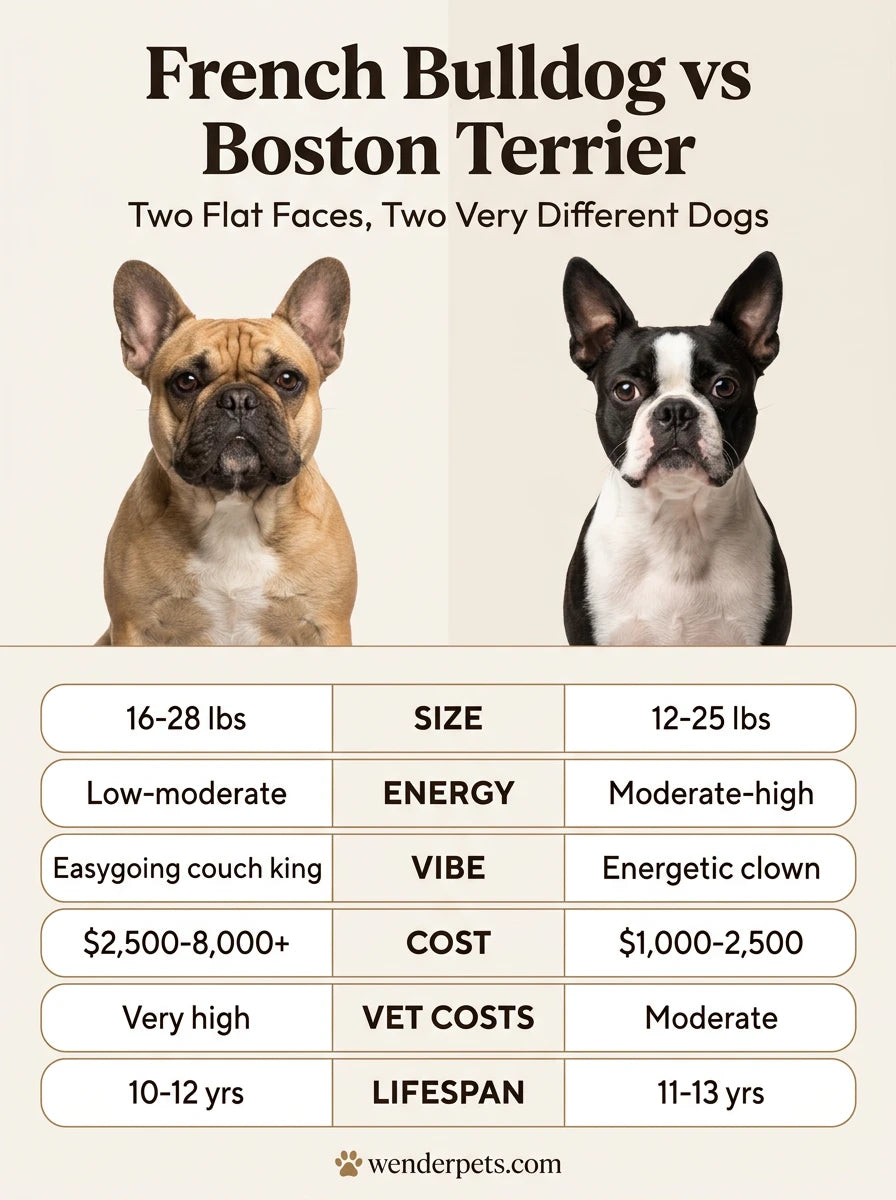
The Quick Comparison
🇫🇷 French Bulldog
- Weight: 20-28 lbs
- Energy: Low to moderate
- Personality: Chill, stubborn, affectionate clown
- Exercise: Short walks, mostly naps
- Price: $2,500-$5,000+
- Vet bills: Prepare your wallet
🇺🇸 Boston Terrier
- Weight: 12-25 lbs
- Energy: Moderate to high
- Personality: Lively, eager to please, the class clown
- Exercise: Real walks, actual play sessions
- Price: $1,000-$2,500
- Vet bills: Still not cheap, but better
Origin Story: Paris vs Boston
The French Bulldog started life as a miniature English Bulldog that traveled to France with Nottingham lace workers in the 1800s. Parisian society fell in love with them. They became the dog of artists, writers, and anyone who wanted a compact companion that looked simultaneously adorable and slightly grumpy.
The Boston Terrier was bred in — you guessed it — Boston, Massachusetts, in the late 1800s. A cross between an English Bulldog and a now-extinct White English Terrier, the Boston was originally a pit fighter. Yes, really. That tuxedo-wearing gentleman was originally bred for the ring. Breeders civilized the breed over generations, selecting for companionship over combat.
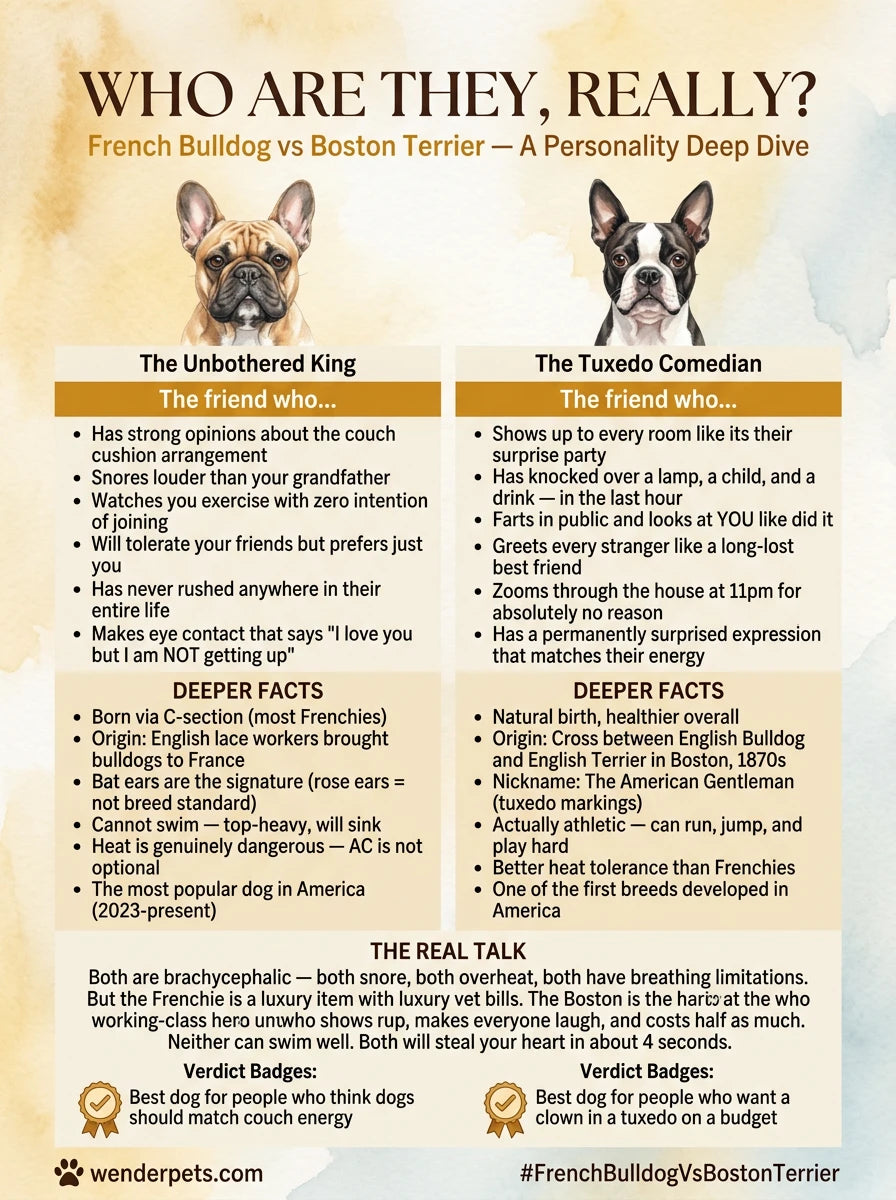
What this means today: Frenchies are bred to be chill. Bostons have vestigial athletic DNA that shows up in surprising bursts of speed and agility. The French Bulldog is the one watching from the couch. The Boston Terrier is the one doing zoomies around it.
Temperament: The Couch Potato vs The Entertainer
Living With a French Bulldog
Frenchies have perfected the art of doing absolutely nothing with maximum charm. They'll follow you from room to room — not to play, but to be near you while they continue doing nothing. They're Velcro dogs with a strong opinion about temperature, noise, and whether that walk is really necessary.
Stubborn? Incredibly. A Frenchie who doesn't want to walk will plant their feet and give you a look that says "carry me or we're not going." They're not dumb — they're selectively motivated. Food works. Praise works sometimes. Commands work when they feel like it.
But when a Frenchie loves you? It's unconditional, slobbery, snore-filled devotion. They're one-person dogs who tolerate everyone else. They're hilarious without trying, making weird sounds that shouldn't come out of a mammal.
Living With a Boston Terrier
Bostons are the friend who shows up with energy and a plan. They want to play. They want to learn tricks. They want to make you laugh. They're sometimes called the "American Gentleman" because of their tuxedo markings, but in practice they're more like the class clown in a tuxedo.
Unlike Frenchies, Bostons are genuinely eager to please. Training a Boston is fun because they want to get it right. They'll try different approaches, watch your face for approval, and celebrate when they nail it. They're emotionally responsive in a way that Frenchies simply aren't.
Bostons are also more athletic than they look. They can run, jump, and play fetch with surprising stamina. Not Border Collie stamina — but enough that a 30-minute play session won't even wind them.
Health: The Brachycephalic Reality
Here's where both breeds share an uncomfortable truth: flat faces come with a price tag.
⚠️ Brachycephalic Obstructive Airway Syndrome (BOAS)
Both breeds are brachycephalic (flat-faced), which means compromised airways, difficulty breathing in heat, and potential need for corrective surgery. French Bulldogs are significantly more affected than Boston Terriers due to their heavier build and more compressed facial structure. Many airlines have banned Frenchies from cargo holds due to in-flight deaths.
🏥 Health Comparison
French Bulldog
- • Lifespan: 10-12 years
- • BOAS: Severe in many individuals
- • Spinal issues (IVDD, hemivertebrae)
- • Skin fold infections
- • Cherry eye, allergies
- • Cannot swim (too top-heavy)
- • 80%+ require C-sections to breed
- • Heat intolerance: extreme
Boston Terrier
- • Lifespan: 11-13 years
- • BOAS: Moderate (less severe)
- • Eye issues (prominent eyes = injuries)
- • Patellar luxation
- • Allergies, deafness (in whites)
- • Can swim (with supervision)
- • More natural births possible
- • Heat intolerance: moderate
The bottom line on health: Boston Terriers are generally the healthier breed. Their lighter build, slightly longer muzzle, and less extreme body proportions mean fewer breathing problems, fewer spinal issues, and lower vet bills over a lifetime. Frenchies are wonderful dogs who deserve love, but the breed's health challenges are significant and getting worse as demand drives less responsible breeding.
Apartment Living: Both Excel, Differently
Both breeds are exceptional apartment dogs — arguably the best in their respective weight classes. No yard? No problem. But how they fill that apartment space differs.
A Frenchie apartment is quiet. These dogs don't bark much (they make other, stranger sounds). They don't need much space to exercise. A short walk, some playtime, and they're content on the couch for the rest of the day. They're ideal for work-from-home professionals who want a warm body next to their desk.
A Boston apartment is livelier. Bostons do bark — not excessively, but they'll alert you to doorbells, delivery drivers, and suspicious squirrels. They need more indoor play, more training games, and more stimulation. They're ideal for singles or couples who want a dog that actively engages with them.
With Kids and Other Pets
Frenchies with kids: Patient and tolerant. They'll put up with a lot from small children. But they're not playmates — they're more like living stuffed animals that occasionally snore.
Bostons with kids: Active playmates. They'll run, chase, and play games with older children. Their terrier heritage means they've got the stamina for it. But their prominent eyes are vulnerable, so teach young kids to be gentle around the face.
With other dogs: Frenchies can be hit-or-miss — some love other dogs, some prefer being the only child. Bostons are generally friendly with other dogs, though same-sex aggression occasionally shows up (that terrier ancestry again).
With cats: Both breeds can coexist with cats. Bostons are more likely to chase initially but usually settle down. Frenchies are usually too lazy to bother.
Cost: The Real Numbers
The French Bulldog is one of the most expensive breeds to buy AND own. Between the purchase price ($2,500-$5,000+), the health issues, and the fact that many require artificial insemination and C-sections to breed, Frenchies are a serious financial commitment.
The Boston Terrier is more affordable across the board. Lower purchase price, fewer health emergencies, and less need for specialized veterinary care. You're still looking at brachycephalic breed costs, but it's meaningfully less than a Frenchie.
💰 Estimated Lifetime Cost (12 years)
French Bulldog
$30,000 - $50,000+
Purchase, food, routine vet, emergency vet, possible surgery
Boston Terrier
$18,000 - $30,000
Purchase, food, routine vet, occasional emergency, eye care
Trainability: Willing vs Stubborn
Training a Boston Terrier is genuinely fun. They're smart, food-motivated, and want to make you happy. They pick up tricks quickly and retain them well. House training is usually straightforward. Their terrier intelligence means they enjoy puzzle toys and problem-solving games.
Training a French Bulldog requires patience and a good sense of humor. They're not unintelligent — they understand perfectly well what you want. They just don't always see why they should do it. Short, reward-heavy sessions work best. If a Frenchie is bored, training is over whether you like it or not.
Climate Considerations
This one matters more than most people realize. Both breeds overheat easily, but Frenchies are in genuine danger in hot weather. If you live in the South (Texas, Florida, Arizona), a Frenchie needs air conditioning access at all times and should never exercise in summer heat.
Bostons handle heat slightly better due to their lighter build but still need careful management. Neither breed is suitable for outdoor-heavy lifestyles in hot climates.
Cold weather: Both breeds get cold quickly. Short coats + low body fat = sweaters aren't just cute, they're necessary. Bostons tolerate cold slightly better than Frenchies, but neither should spend extended time outdoors in winter.
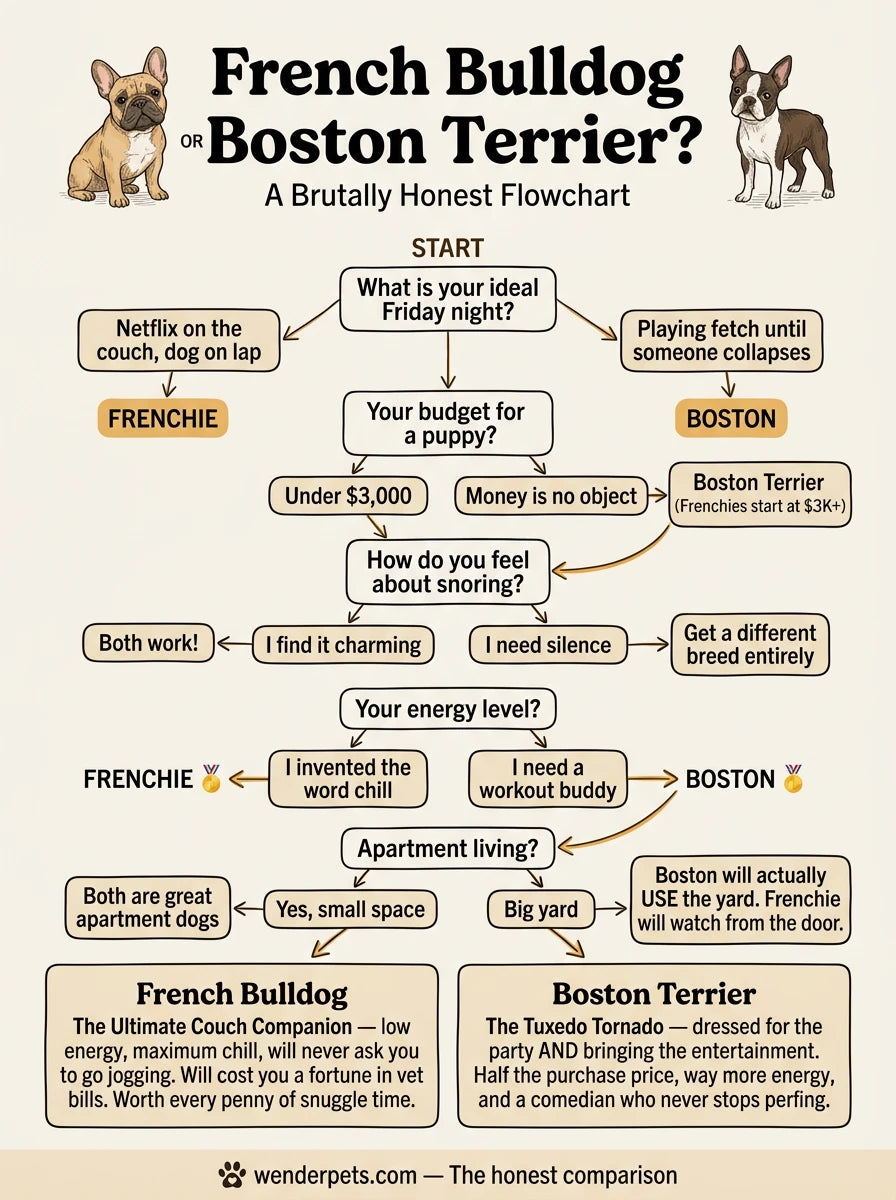
The Verdict
Choose a French Bulldog if you...
- • Want the ultimate low-energy companion
- • Work from home and want a desk buddy
- • Have a healthy budget for veterinary care
- • Appreciate stubbornness as a personality feature
- • Live in a climate-controlled environment
- • Love weird snoring sounds at 2 AM
Choose a Boston Terrier if you...
- • Want an active, trainable companion
- • Have kids who need a playmate
- • Prefer a healthier breed with lower vet bills
- • Want a dog that's eager to learn tricks
- • Like the flat-face look with fewer health tradeoffs
- • Enjoy a dog that makes you laugh on purpose
Both the French Bulldog and the Boston Terrier are exceptional companion dogs. The Frenchie is a lifestyle choice — a commitment to a specific kind of lazy, lovable, expensive companionship. The Boston is a versatile little athlete in a tuxedo who's ready for whatever you've got planned.
Either way, you're getting a flat-faced friend with a personality three times bigger than their body. And really, isn't that the whole point?
🎁 Celebrate Your Compact Companion
Frenchie person or Boston fan? We've got breed-specific gifts for both — because every flat face deserves to be celebrated.
French Bulldog Gifts →Boston Terrier Gifts →