Wender Pets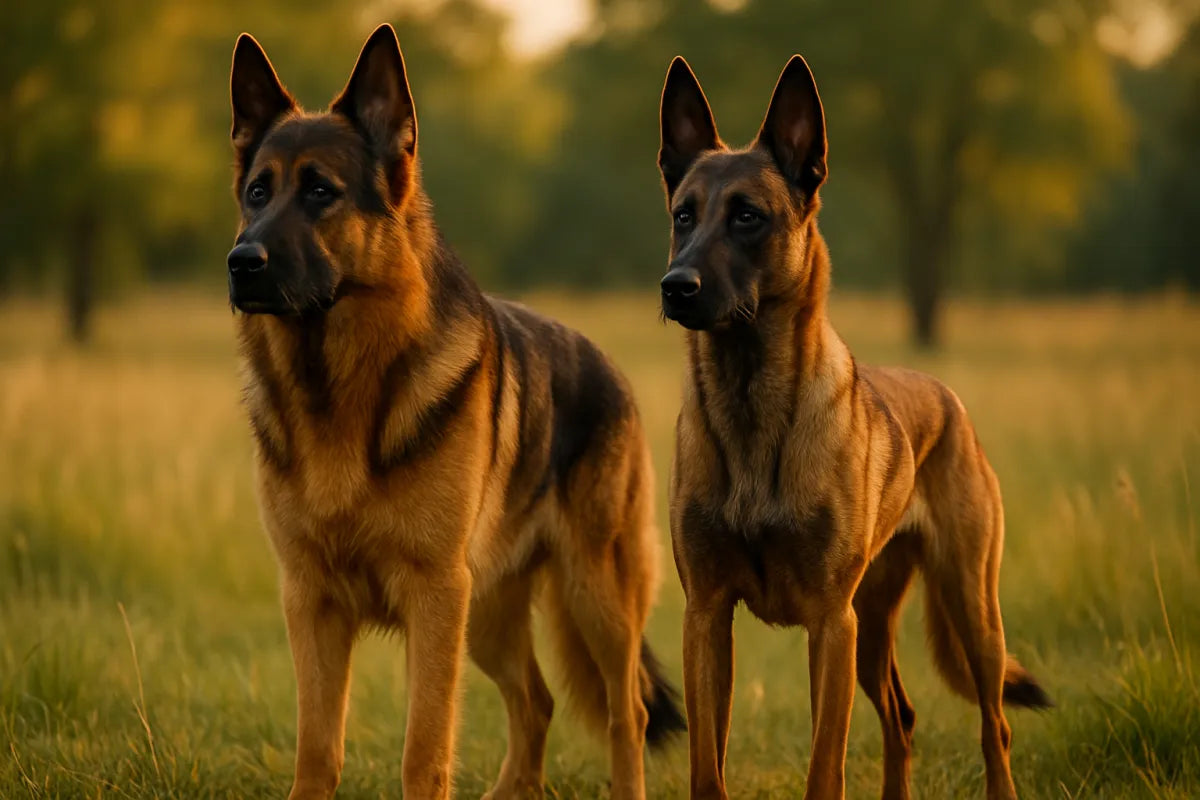
If the Golden Retriever vs Lab debate is "which amazing family dog do I pick?", the German Shepherd vs Belgian Malinois debate is "how much working dog can I actually handle?"
Both breeds are intelligent, driven, and athletic. Both dominate K-9 units, military operations, and protection sports worldwide. Both will bond deeply with their handler and protect their family without hesitation.
But one is a BMW. The other is a Formula 1 car. And most people shouldn't be driving a Formula 1 car to the grocery store.
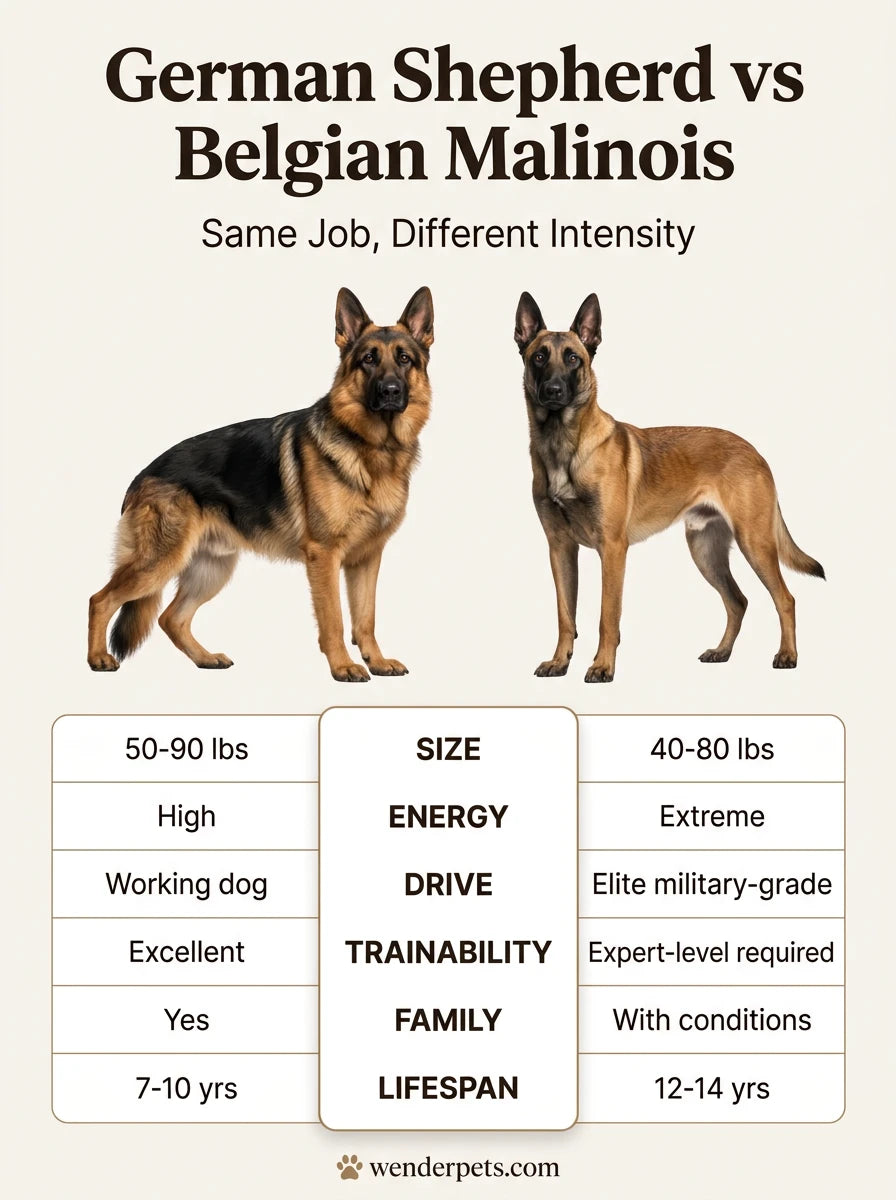
The Quick Comparison
🇩🇪 German Shepherd
- Weight: 65-90 lbs
- Energy: High
- Drive: 7/10 — intense but has an off switch
- Family friendly: Excellent with proper socialization
- First-time owner? Possible with commitment
- The vibe: Loyal soldier who also loves belly rubs
🇧🇪 Belgian Malinois
- Weight: 40-80 lbs
- Energy: Extreme
- Drive: 11/10 — what off switch?
- Family friendly: Can be, with experienced handling
- First-time owner? No. Respectfully, no.
- The vibe: Spec ops operator who never clocks out
Origin Story: The Reliable vs The Extreme
The German Shepherd Dog was created in 1899 by Captain Max von Stephanitz, who wanted the perfect all-purpose working dog. He succeeded spectacularly. GSDs became the world's most recognizable working breed — police dogs, military dogs, search and rescue dogs, guide dogs, herding dogs. They do everything well because they were designed to do everything well.
The Belgian Malinois came from the Belgian city of Malines, bred as a herding dog that gradually proved itself in police and military work. For decades, the Malinois was a niche breed — respected by professionals, unknown to the public. Then the military started replacing German Shepherds with Malinois for special operations (including the raid that got Bin Laden), and suddenly everyone wanted one.
The critical difference: German Shepherds were bred to be versatile — good at many things. Belgian Malinois were bred (and increasingly selected) for extreme drive and intensity. The GSD is a Swiss Army knife. The Malinois is a scalpel.
Temperament: Dialed Up vs Dialed to 11
Living With a German Shepherd
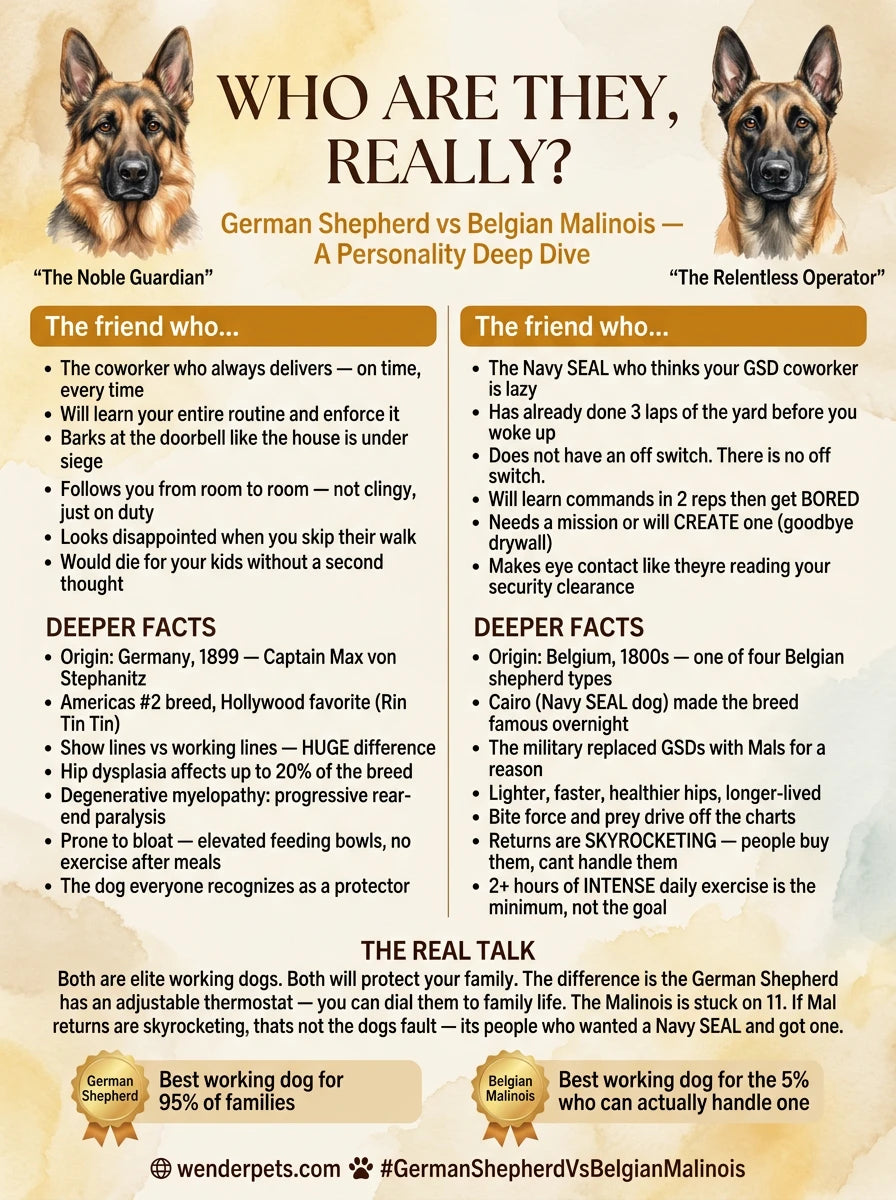
A well-bred German Shepherd is one of the great pleasures of dog ownership. They're loyal to the point of being velcro — your GSD will follow you everywhere and position themselves between you and anything they perceive as a threat. They're serious dogs with a sense of duty, but they're also capable of genuine goofiness with their family.
The GSD has what experienced handlers call "an off switch." After a vigorous training session or long walk, a well-exercised German Shepherd can settle on the living room floor and just... be there. Calm. Present. Watching, always watching, but relaxed.
They're protective without being aggressive (when properly socialized). They'll bark at strangers and position themselves strategically, but a well-trained GSD can distinguish between a delivery driver and an actual threat. They think before they act.
With their family, they're surprisingly gentle. Many GSD owners are shocked by how tender their 85-pound dog is with children, cats, and other pets. They seem to understand that different situations require different levels of intensity.
Living With a Belgian Malinois
Here's where the honest conversation needs to happen.
A Belgian Malinois is not a German Shepherd with shorter hair. A Malinois is a fundamentally different animal in terms of drive, energy, and intensity. If a GSD is "high energy," a Malinois is "why is this dog vibrating?"
The Malinois doesn't have an off switch. They have a "slightly lower" switch. Even at rest, a Malinois is scanning, processing, waiting for the next task. They need 2-3 hours of vigorous physical AND mental exercise daily — not leisurely walks, but structured training, bite work, agility, or high-intensity play.
Under-stimulate a Malinois and you won't get a bored dog. You'll get a dog that remodels your house with its teeth. Malinois who don't get adequate outlets will redirect their drive into destructive, neurotic, or aggressive behavior. This is why breed-specific rescue organizations are overflowing with Malinois surrendered by owners who didn't understand what they were getting.
But — and this is important — a properly handled Malinois in the right home is breathtaking. Their focus is laser-sharp. Their responsiveness to training is unmatched. Their bond with their handler is so tight it borders on psychic. If you train professionally, compete in protection sports, or work in law enforcement, the Malinois may be the most rewarding dog you'll ever own.
Intelligence and Trainability
Both breeds are in the top tier of canine intelligence. But "smart" means different things for each.
German Shepherd intelligence is thoughtful. They process information, consider context, and make decisions. A GSD will learn a new command in 5-10 repetitions and retain it. They're versatile learners — equally good at obedience, tracking, protection, and service work. They can generalize commands to new situations without needing to be retaught.
Belgian Malinois intelligence is explosive. They don't just learn — they demand to learn. New information is processed at speed. A Malinois will learn a command in 3-5 repetitions but will also be bored of it by repetition 20. They need constant progression, new challenges, and increased difficulty. Stale training = disengaged Malinois = trouble.
🎯 Training Comparison
German Shepherd
- • Learns quickly, retains well
- • Tolerates repetition
- • Responds to firm but fair handling
- • Good for: obedience, tracking, service, protection
- • Can be handler-soft (respond poorly to harshness)
- • First-time trainable with guidance
Belgian Malinois
- • Learns extremely fast
- • Gets bored with repetition
- • Needs precise, clear communication
- • Good for: bite work, agility, detection, IPO/IGP
- • Can be handler-hard (pushes boundaries)
- • Requires experienced handler
Physical Differences
At a glance, the two breeds can look similar — especially to people who don't know dogs well. But the physical differences are significant and affect how they perform.
German Shepherds are heavier (65-90 lbs vs 40-80 lbs) with a more sloped back line, deeper chest, and heavier bone structure. They're built for endurance and power. The breed has unfortunately been split into "show line" and "working line" types — show-line GSDs have that extreme sloped back that can cause hip problems, while working-line GSDs maintain a more natural structure.
Belgian Malinois are lighter, leaner, and more athletic. They're built for speed and agility — think sprinter vs powerlifter. A Malinois can jump 6-8 feet vertically and scale walls. Their lighter frame means fewer joint problems but also less raw stopping power. They're the athlete's athlete.
Health: The GSD's Achilles Heel
🏥 Health Comparison
German Shepherd
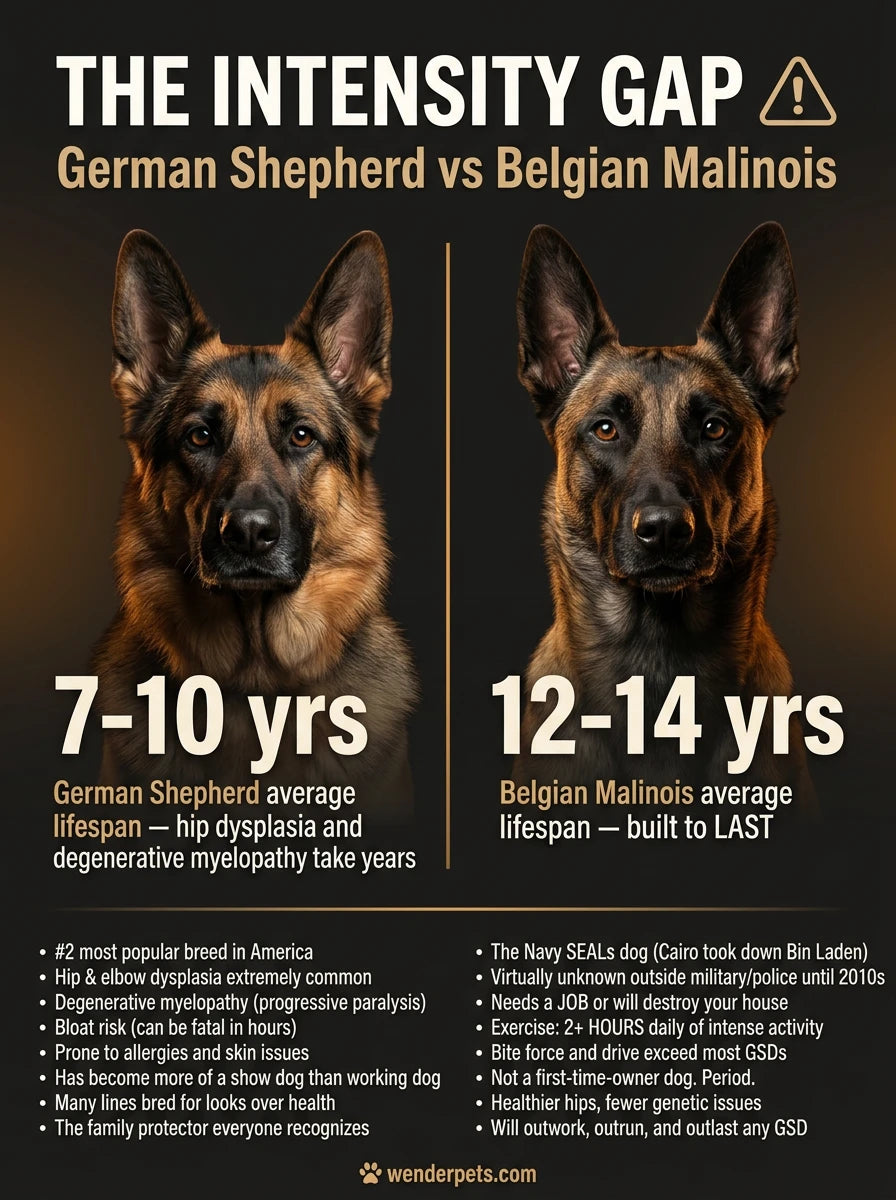
- • Lifespan: 9-13 years
- • Hip/elbow dysplasia: very common
- • Degenerative myelopathy
- • Bloat (GDV)
- • EPI (exocrine pancreatic insufficiency)
- • Allergies and skin issues
- • Show lines: worse structural problems
Belgian Malinois
- • Lifespan: 12-14 years
- • Hip/elbow dysplasia: present but less common
- • Eye problems (PRA, cataracts)
- • Bloat (GDV) — less common due to lighter build
- • Generally healthier breed overall
- • Injury-prone (they push themselves hard)
- • Working lines: well-maintained genetics
The Malinois has a significant health advantage. Because the breed has been primarily maintained by working dog breeders (not show breeders), the Malinois gene pool is in better shape. Working dogs that can't work get removed from breeding programs. This ruthless selection has kept the breed physically sound.
The German Shepherd, unfortunately, has been split by the show ring. Show-line breeders have exaggerated the sloped back and angulation to the point where some show GSDs can barely trot naturally. Working-line GSDs are structurally sound, but the breed as a whole carries higher rates of hip dysplasia and degenerative myelopathy than any comparable breed.
If you choose a GSD: Buy ONLY from breeders who health-test (OFA hips and elbows minimum). Working-line breeders generally produce healthier dogs. Avoid extreme angulation.
Protection and Guarding
Both breeds are natural protectors, but their approach is different.
German Shepherds are territorial guardians. They establish a perimeter — your house, your yard, your family — and patrol it. They bark at strangers, escort visitors with watchful eyes, and position themselves strategically. A GSD's protection is primarily deterrent. Most threats are resolved by the simple fact that an 85-pound German Shepherd is standing there, staring.
Belgian Malinois are active defenders. Where a GSD watches and waits, a Malinois is already calculating approach angles. Their protection is more handler-directed — they respond to threats with speed and commitment that's frankly intimidating. This is why they're preferred for special operations: they don't just guard, they engage.
For home protection: The GSD is actually the better choice for most families. Their deterrent presence, deeper bark, and ability to read situations make them excellent home guardians without specialized training. A Malinois without proper protection training can be unpredictable — their intensity needs professional direction.
Family Life: The Make-or-Break Question
German Shepherds with families: Outstanding. A properly socialized GSD is gentle with children, tolerant of household chaos, and deeply devoted to every family member. They're the breed that lies at the foot of the bed, walks the kids to the bus stop, and alerts you when something's wrong. They need exercise and mental stimulation, but they can integrate into a normal family rhythm.
Belgian Malinois with families: Possible, but it takes work. A Malinois can be wonderful with children — but only if their exercise and training needs are fully met. An under-stimulated Malinois in a busy household is a recipe for nipping, herding children, and redirected drive. The Malinois needs a dedicated handler (usually one family member) who commits to being their person. Casual family-dog life is not their natural setting.
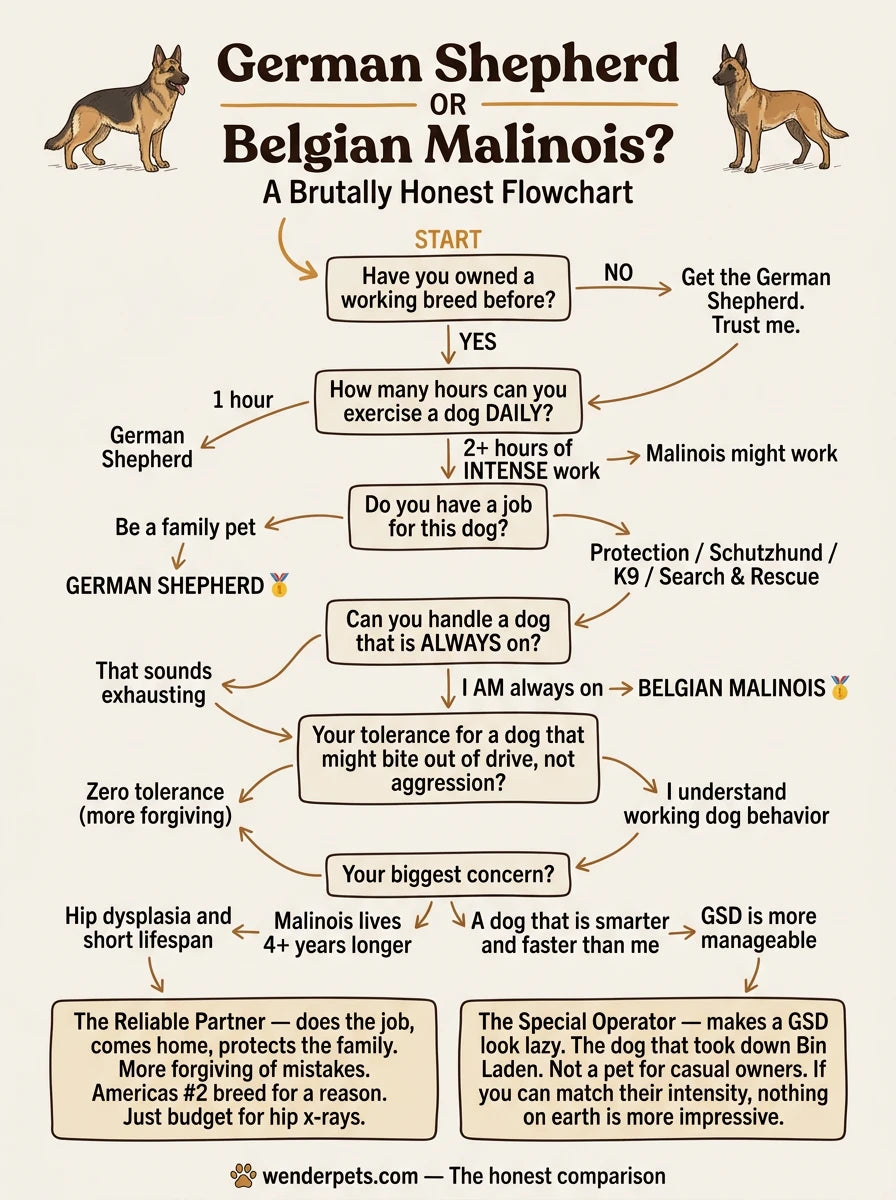
Here's the uncomfortable truth that Malinois fans don't always say out loud: most families should get the German Shepherd. The Malinois is a phenomenal breed for the right person. But "the right person" is a small subset of dog owners — people with experience, time, energy, and the willingness to structure their daily life around their dog's needs.
The "Malinois Wash" Problem
The Belgian Malinois is the most surrendered working breed in America. Breed-specific rescues can't keep up with the intake. The reason is always the same story:
- Person watches a video of a Malinois doing something incredible
- Person buys a Malinois puppy
- Puppy is... a lot
- Adolescent Malinois is destructive, nippy, and never stops moving
- Owner surrenders dog at 8-18 months
This is not the dog's fault. It's a mismatch of expectations. If you're reading this article trying to decide between the two breeds and you've never owned a high-drive working dog before, the German Shepherd is your answer. Get a GSD, learn what working-breed ownership looks like, and if you still want a Malinois after a few years of that experience, you'll be ready.
Who Else Should You Consider?
If neither the GSD nor the Malinois feels quite right, here are alternatives worth exploring:
- Dutch Shepherd: Similar to the Malinois but slightly more balanced. A good middle ground.
- Doberman Pinscher: Elegant, loyal, and protective without the herding drive complications.
- Rottweiler: Calm confidence, powerful deterrent, lower exercise needs than either GSD or Malinois.
- Cane Corso: Imposing guardian with a surprisingly gentle family side.
The Verdict
Choose a German Shepherd if you...
- • Want a versatile family protection dog
- • Are an active owner but have a normal job and schedule
- • Want a dog that can "turn off" at the end of the day
- • Have children or plan to start a family
- • Are willing to commit to daily exercise (1-2 hours)
- • Want a deep, loyal bond without extreme management needs
Choose a Belgian Malinois if you...
- • Have significant experience with working breeds
- • Train or compete in protection sports, agility, or detection
- • Can commit 2-3+ hours daily to exercise and training
- • Want an athletic partner for high-intensity activities
- • Understand that this dog will be your primary hobby
- • Have already owned a GSD and want "more"
The German Shepherd is one of the greatest dogs ever created — versatile, loyal, protective, and capable of fitting into a normal family life while still being an extraordinary working animal. There's a reason it's been the world's most popular working breed for over a century.
The Belgian Malinois is a masterpiece of working dog genetics — focused, explosive, and capable of things that border on superhuman. In the right hands, there's nothing they can't do.
The question isn't which breed is better. It's which one matches your actual life — not your fantasy life, not your Instagram life, but the life you live every Tuesday at 6 PM when you're tired from work and it's raining and your dog still needs two hours of structured activity.
Choose honestly. Both breeds deserve an owner who's ready for what they bring.
🎁 Honor Your Working Dog
Whether your partner wears a GSD's noble coat or a Malinois's tactical build, celebrate the breed that chose you. Explore our working dog collections.
German Shepherd Gifts →Belgian Malinois Gifts →