 Wender Pets
If you own a big dog, you know the math. A Great Dane is doing well to make eight. A Saint Bernard at nine is a senior citizen. An English Mastiff at ten is exceptional. Meanwhile, your friend with the Chihuahua casually mentions that their dog is sixteen and still demanding breakfast at 5 a.m. The cosmic injustice of this is something every big-dog owner has spent at least one quiet evening thinking about.
For decades, that math felt fixed. You picked your breed, you knew the deal, you tried to be grateful for the time you got. Now, for the first time, there is a drug in late-stage development that is specifically designed to change those numbers. It is called LOY-001. It is being made by a San Francisco company called Loyal. And in late 2023, the FDA took the unusual step of agreeing that Loyal's data supports a "reasonable expectation of effectiveness" for extending healthy lifespan in large breed dogs. That phrase is not regulatory boilerplate. It is the agency saying, in writing, that this might actually work.
If LOY-001 clears its remaining manufacturing and safety reviews, it will be the first drug ever approved by the FDA specifically to extend the healthy lifespan of any animal, dogs or otherwise. Loyal is targeting market availability in 2026.
So what is it, what does it actually do, and should you be putting your dog on a waitlist? Let us walk through this carefully, because the gap between the headlines and reality is wider than most coverage admits.
Why Big Dogs Die Young in the First Place
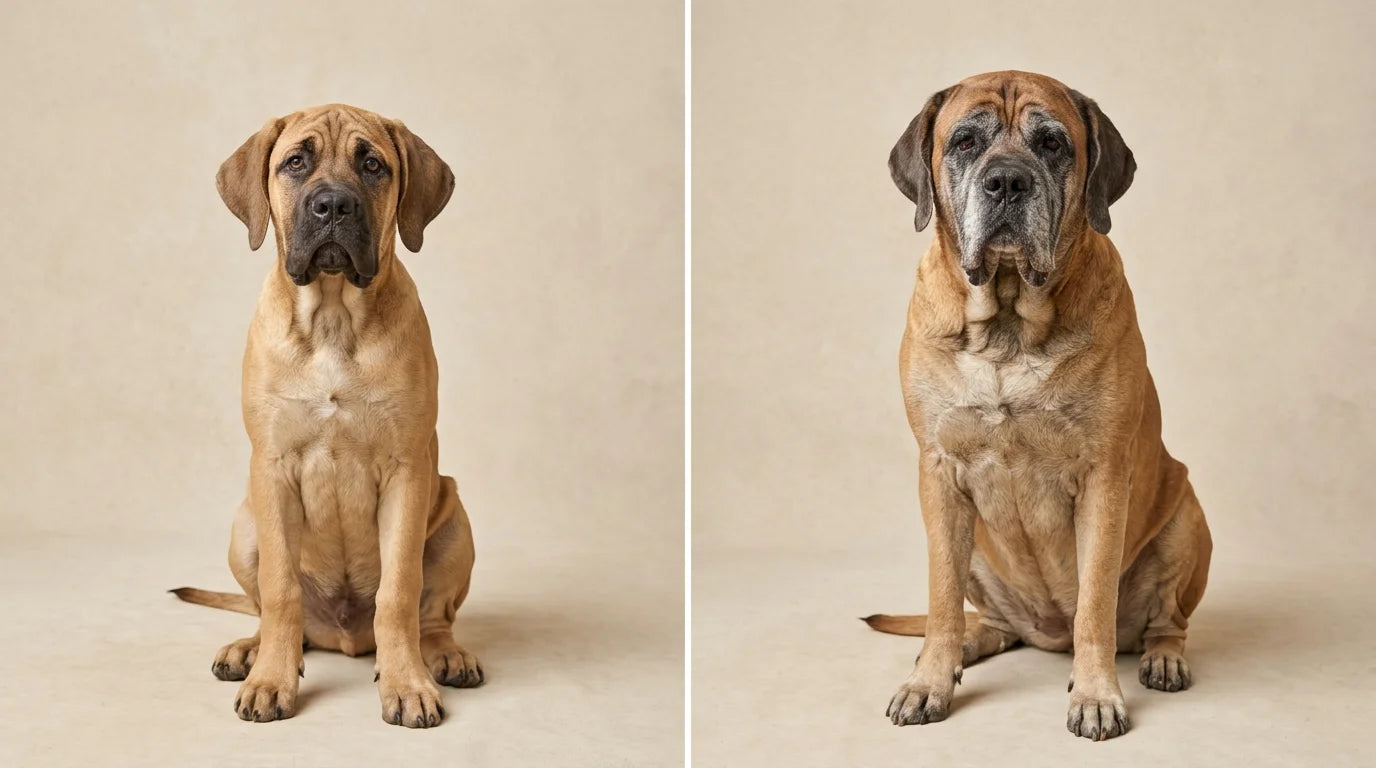
To understand why LOY-001 might work, you have to understand why size shortens lifespan in dogs. This is one of the strangest patterns in mammalian biology. Across species, bigger animals usually live longer. Elephants outlive mice. Whales outlive dolphins. Humans outlive cats. But within the species Canis lupus familiaris, the rule reverses, and it reverses violently. A 5-pound Yorkshire Terrier can live 16 years. A 150-pound English Mastiff rarely sees seven.
The reason, researchers now believe, is a hormone called insulin-like growth factor 1, or IGF-1. IGF-1 is what tells a body to grow. Big dogs were bred for size, which means they were bred, accidentally, for elevated IGF-1 levels. The same hormonal signaling that builds a Great Dane's enormous frame in the first 18 months of life keeps grinding away in the background for the rest of that dog's life, accelerating cellular aging, fueling cancer pathways, and stressing organ systems that were never designed to support that mass for long.
In essence, we bred a body that grows fast and dies fast, and we did it by selecting for a hormone that has a back end nobody planned for. The exact mechanism is more complicated than this, but that is the headline. Big-dog longevity is, in significant part, a hormonal accelerator that never gets released.
LOY-001 is the first attempt to take a foot off that pedal.
What LOY-001 Actually Is
LOY-001 is an injectable drug administered by a veterinarian every three to six months. It works by lowering circulating IGF-1 levels in dogs that have abnormally high levels because of selective breeding. The goal is not to make your dog feel younger or perform better in the moment. The goal is to slow the rate of biological aging itself, so that the dog reaches old age later and stays in healthy old age longer.
Loyal is targeting LOY-001 specifically at dogs 7 years and older that weigh at least 40 pounds. The dosing schedule of every three to six months is itself part of the value proposition. It is meant to be a "twice a year at the vet" kind of intervention rather than a daily pill, which is a meaningful design choice. Dogs are notoriously bad at taking pills consistently, and big-dog owners are already managing more than their share of joint supplements, glucosamine, and arthritis NSAIDs.
Important nuance: The FDA has agreed that Loyal's data supports a "reasonable expectation of effectiveness" under the conditional approval pathway. The drug itself has not yet received conditional approval. Loyal still needs to clear manufacturing and safety reviews before LOY-001 can be sold. As of mid-2026, the company is targeting market availability later this year, but timelines in pharmaceutical regulation are not promises.
Which Dogs Qualify
Loyal's clinical work has focused on large and giant breeds. The label, when it comes, will reflect that. If you own one of these breeds, you are squarely in the conversation:
Breeds Most Likely to Be Eligible
Giant breeds (lifespan 7 to 10 years)
Great Dane · English Mastiff · Saint Bernard · Newfoundland · Irish Wolfhound · Leonberger
Large breeds (lifespan 9 to 12 years)
Bernese Mountain Dog · Rottweiler · Cane Corso · Doberman · German Shepherd · Labrador Retriever · Golden Retriever
Final eligibility will follow Loyal's approved label, which is expected to specify minimum weight (40 lbs) and minimum age (7 years).
Notably, Loyal is also developing a separate drug, LOY-002, aimed at smaller dogs and at a different aging mechanism (metabolic dysfunction in senior dogs of any size). LOY-002 received its own positive FDA milestone in 2024 and is on a parallel track. So if you have a Cavalier rather than a Cane Corso, you are not out of the conversation, just on a different timeline.
What LOY-001 Will Not Do
This is the part of the coverage that gets glossed over. LOY-001 is not a fountain of youth. It will not make your senior Great Dane act like a puppy again. It will not reverse arthritis, cure cancer, fix heart disease, or undo the damage of bad nutrition over the previous seven years.
What Loyal claims, based on the data submitted to the FDA, is that LOY-001 can extend healthy lifespan, meaning the years of life the dog has before serious decline begins. The mechanism is preventive and metabolic, not regenerative. Once age-related disease has taken hold in a particular system, this drug is not designed to undo it.
Said plainly: this is a drug for dogs that are still doing well, given early enough to slow the slope of the decline. It is not a rescue drug for a senior dog already in crisis. The veterinarians who will eventually prescribe it will need to think carefully about the right window. Too early in life and you may be intervening on a system that is not yet driving aging. Too late and you are trying to slow a fall that has already happened.
The Cost Question
Loyal has indicated a target price in the range of roughly $40 to $90 per month, which works out to a yearly cost in the ballpark of $500 to $1,100, before veterinarian administration fees. Add the cost of the office visits required to administer the injection (probably two to four per year), plus the bloodwork that will likely be required to monitor IGF-1 levels and rule out side effects, and the realistic annual all-in cost is probably closer to $1,000 to $1,800 per dog.
For perspective, the average American dog owner spends about $1,500 to $2,500 per year on a healthy dog already, between food, preventive care, and routine vet visits. A giant-breed dog costs significantly more than that. So LOY-001 represents, roughly, a doubling of routine vet spend for owners who choose it.
Whether that is worth it depends on numbers Loyal has not yet released publicly. The relevant question is not "does it extend lifespan" (the FDA already accepted that the data is reasonable on that point) but "by how much, and at what cost in side effects." Until peer-reviewed efficacy data is published with a specific extension number attached, anyone telling you exactly how many extra months your dog will get is guessing.
The Boring Drugs That Already Work

Here is the thing nobody wants to say in a story about a buzzy biotech: most of the lifespan you can buy your big dog is already on the table, today, for free. Multiple peer-reviewed studies, including a landmark 14-year study by Purina, have shown that keeping a dog at a lean body weight extends median lifespan by about 1.8 years, which is roughly 15 to 20 percent. That is bigger than the effect any pharmaceutical has yet demonstrated.
The unsexy interventions that move the most lifespan in big dogs are well-established:
- Lean body weight. A dog that is even slightly overweight loses years. The Purina study showed dramatic effects.
- Joint protection from puppyhood. Big dogs that grow too fast develop joint disease that compounds for life. Slow growth, controlled exercise on growing joints, and high-quality large-breed puppy food matter enormously.
- Annual senior bloodwork starting at age 5. Catching kidney, liver, and thyroid issues early is the difference between management and crisis.
- Dental care. Periodontal disease is associated with cardiac, renal, and hepatic damage in older dogs. Regular cleanings genuinely extend life.
- Reasonable exercise that is not joint-destroying. Daily walks, swimming, and controlled play extend lifespan. Hours of high-impact running on hard surfaces does not.
If you do those five things consistently for the first decade of a giant-breed dog's life, you have already given that dog a meaningful gift, regardless of whether LOY-001 ever makes it to your vet's freezer.
What This Moment Actually Means
Step back from LOY-001 specifically and look at the bigger frame. A pharmaceutical company successfully convinced the FDA that a drug designed to slow biological aging is reasonable enough to consider for approval. That has never happened before in the history of veterinary medicine, and it has obvious implications for human medicine, where the same scientific debate (whether aging itself can be treated as a condition) has been raging for years.
Big-dog owners are about to become accidental pioneers in a field of medicine that may, within our lifetimes, change how human aging is treated. That is not a small footnote. It is one of the more consequential things happening in animal health right now, and it is happening because we collectively bred a population of large dogs who needed it badly enough that someone built a company around the problem.
Should You Be Doing Anything Now?
If you have a giant or large breed dog under the age of seven, the answer is: not yet, but pay attention. The drug is not yet on the market. The price is not yet locked in. The exact eligibility criteria will be set by the approved label, not by speculation. There is no benefit to your dog in trying to act before the actual product exists.
What you can do today is everything in the "boring drugs that work" list above, because those interventions need years of consistency to deliver, and the dog you put on LOY-001 in 2027 will benefit far more if she has been kept lean and well-monitored for the previous decade.
If your dog is already a senior in the eligible range when LOY-001 launches, talk to your veterinarian, not to the internet. Ask specifically what the label indicates, what the bloodwork requirements are, and whether your dog's existing health profile (cancer history, kidney function, cardiac status) makes the drug a reasonable bet. The honest vets are going to be cautious. That is the right posture for a brand-new mechanism of action with a regulatory approval still in progress.
The Bottom Line
LOY-001 is real, it is on track, and if it lands in 2026 it represents the first time a pharmaceutical has been approved specifically to extend a dog's healthy lifespan. For owners of Great Danes, Mastiffs, Berneses, Saint Bernards, and other breeds whose lifespan math has always been heartbreaking, that matters.
It is not a miracle, it is not free, and it does not replace the fundamentals of weight management and preventive care that already give your dog the most lifespan you can buy. But it is the first credible additional tool in a category that has been entirely empty for as long as we have been keeping dogs.
For an owner who has watched a beloved giant breed slow down at six and leave at eight, even a real one-year extension at the end of a healthy life is not a small thing. It is the conversation we have been wanting to have for a hundred years. We are about to actually have it.