 Wender Pets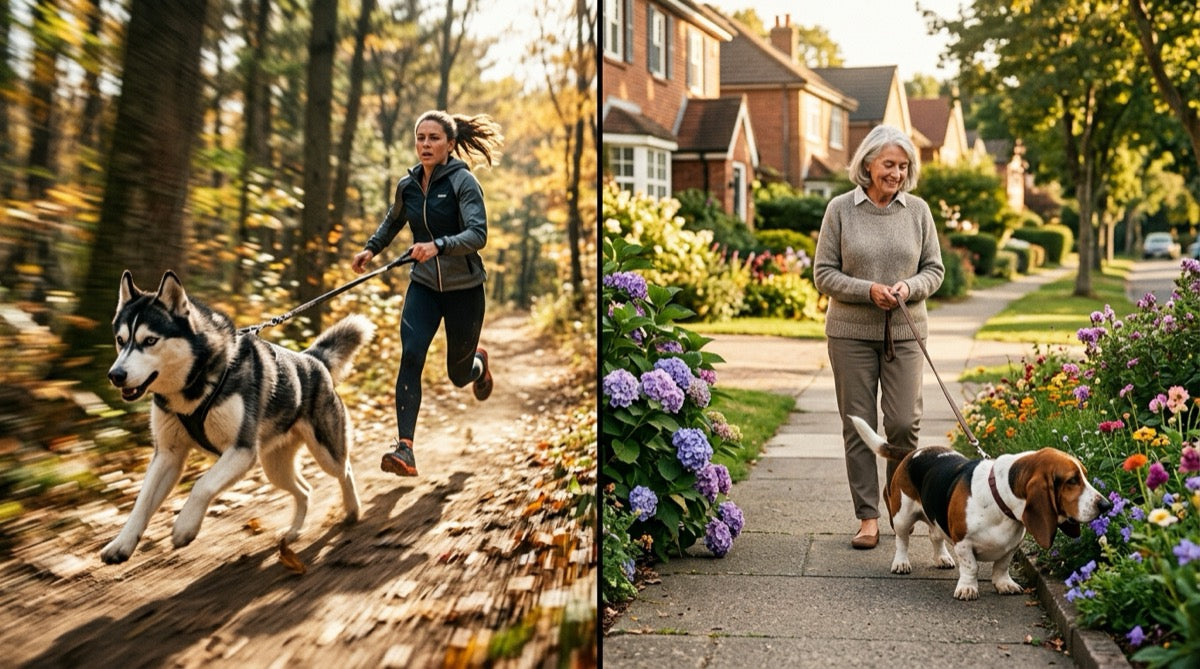
The Walk Reveals Everything
There's a moment on every walk where you can tell whether a dog and its owner are actually matched. It's not about obedience training or the right harness. It's about energy. The dog that trots calmly beside you, checking in with a glance every few steps, isn't well-trained — it's well-matched. Its body is getting what it needs. Its brain is getting what it needs. The walk is a partnership, not a negotiation.
Then there's the other walk. The one where the dog is three feet ahead, leash taut, nose locked on something invisible, pulling with a force that seems disproportionate to its body mass. The owner is leaning back, arm extended, already tired, and it's been four minutes. That dog isn't bad. It's bored. It's under-exercised. It's a sports car in a school zone, and the walk is the only outlet it has — so it's going to use every second of it at maximum intensity.
The mismatch between a dog's exercise needs and its owner's lifestyle is one of the biggest reasons dogs end up in shelters. Not aggression. Not allergies. Energy. Pure, unrelenting, genetically programmed energy that has nowhere to go. So let's talk about what different breeds actually need — and what happens when they don't get it.
The High-Energy Breeds: Born to Run
These are the dogs that don't walk — they launch. A 30-minute stroll around the block isn't exercise for them; it's an insult. They were bred for jobs that required sustained, intense physical effort, and that programming doesn't switch off because you live in a condo.
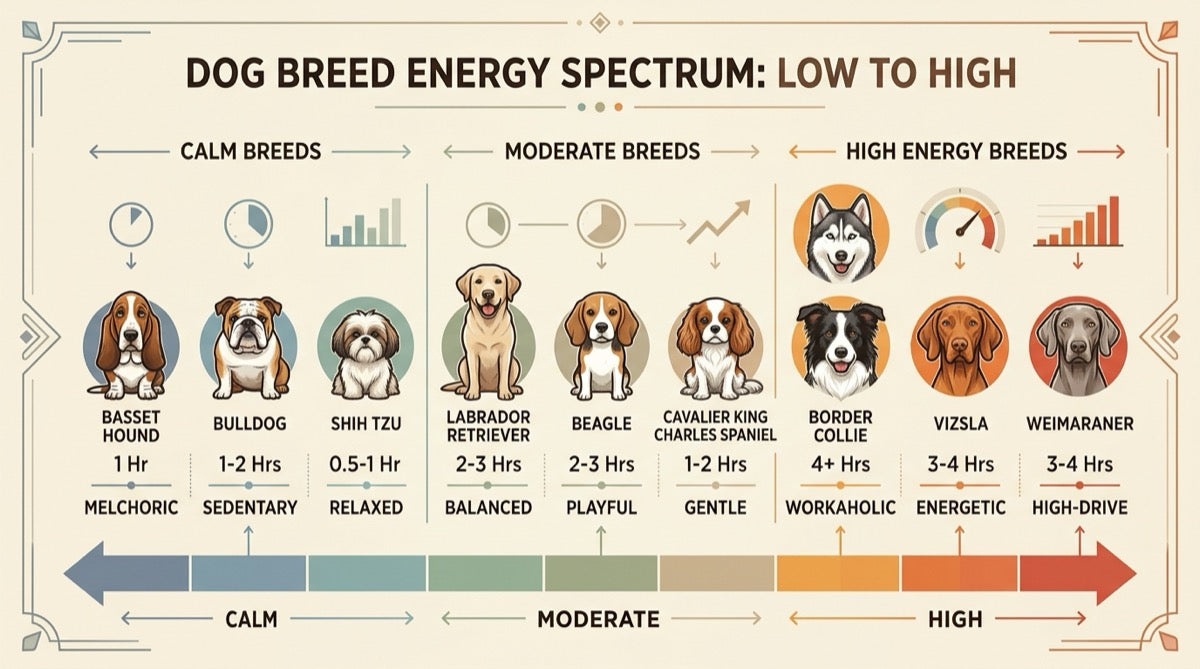
The Border Collie sits at the top of this category — arguably the most driven dog on the planet. Bred to herd sheep across Scottish hillsides for hours without rest, a Border Collie without a job will invent one. Usually that job involves herding your children, obsessively chasing shadows, or developing compulsive behaviors that look a lot like anxiety. They need a minimum of 90 minutes of vigorous activity daily, and "vigorous" means running, agility courses, or herding — not a leisurely walk. A tired Border Collie is a happy Border Collie. An untired one is a disaster.
The Vizsla is the endurance athlete of the dog world — a Hungarian hunting breed built for stamina, not just speed. Vizslas were designed to run alongside hunters all day, covering 20-30 miles over rough terrain. They're also what breeders call a "Velcro dog," meaning they want to do all of that running while physically touching you. A Vizsla that doesn't get at least an hour of hard running daily will redirect that energy into anxiety, whining, and the kind of clinginess that makes you feel like you're being stalked in your own house.
The Siberian Husky was literally bred to run 100+ miles a day pulling a sled through Arctic conditions. Let that sink in. One hundred miles. Your morning jog around the park is a warm-up for a Husky. Without extreme physical outlet, they howl (not bark — howl), escape, dig, and destroy furniture with the efficiency of a demolition crew. They're also escape artists of legendary proportions — a bored Husky will jump 6-foot fences, open doors, and find gaps in security you didn't know existed.
The Australian Shepherd combines the Border Collie's work drive with an even more intense need for human connection. Aussies don't just need exercise — they need to exercise with you. Left alone, even in a big yard, they'll develop separation anxiety and destructive habits. They thrive with 1-2 hours of active engagement: frisbee, agility, hiking, anything that involves both physical effort and partnership.
And then there's the Weimaraner — the Gray Ghost. Built for full-day hunts over German terrain, Weimaraners carry the same separation anxiety as Vizslas but in a bigger, more powerful package. A Weimaraner left alone without adequate exercise won't just whine — it will chew through drywall. They need serious daily runs, and they need them with their person.
The Moderate-Energy Breeds: The Sweet Spot
This is where most families actually belong — and where the best matches happen. These breeds want exercise, enjoy walks, and have real athletic ability, but they also have an off switch. They can run with you in the morning and nap on the couch in the afternoon without losing their minds.
The Labrador Retriever is America's most popular breed for a reason. Labs are genuinely versatile — they'll hike 10 miles with you, swim for an hour, or play fetch until your arm gives out, and then happily crash on the floor while you watch TV. They need about 60-90 minutes of daily activity, which can be split between a morning walk and an afternoon play session. The catch: Labs under age 3 are significantly higher energy than adult Labs, and many people underestimate how much exercise a young Lab actually requires. A bored adolescent Lab will eat your furniture. Literally.
The Golden Retriever matches the Lab's energy profile with slightly more sensitivity. Goldens are eager to please to a fault — they'll match your energy level, whether that's a morning run or a slow walk. They need about an hour of daily exercise, and they're one of the few breeds that genuinely adapts to their owner's pace rather than demanding their own. That said, Goldens who don't get enough activity will gain weight alarmingly fast. An overweight Golden is one of the saddest, most common sights in veterinary offices.
The Beagle is deceptively athletic for its size. Bred as pack hunters, Beagles have real stamina and enjoy long walks — but they're also perfectly content with moderate daily exercise (45-60 minutes). The challenge with Beagles isn't energy management, it's nose management. A Beagle on a walk will follow a scent trail with the single-mindedness of a detective, and no amount of leash training will fully override 1,000 years of olfactory programming. Walk with them, not against them.
The Cocker Spaniel rounds out this group — a sporting breed that's adapted remarkably well to family life. Cockers need a solid 45-60 minutes of activity daily and genuinely enjoy it. They're happiest on walks that involve some variety: different routes, some off-leash time in a safe area, maybe a swim. They're one of the best breeds for people who want an active companion without the extreme demands of the high-energy group.
The Low-Energy Breeds: Couch Connoisseurs
These are the dogs that look at a flight of stairs and consider whether it's worth the effort. They still need daily walks — every dog does — but their idea of a good time is a 20-minute stroll followed by six hours of sleep. They're perfect for apartment dwellers, older owners, or anyone who values a calm home.
The Basset Hound is the patron saint of low energy. Those short legs, long ears, and mournful eyes aren't just adorable — they're indicators of a dog that was bred for slow, methodical tracking, not speed. A Basset needs about 30-40 minutes of daily walking, and it will complete that walk at a pace that makes you question whether time has slowed down. They're also spectacularly stubborn, which means the walk happens on their schedule, not yours. But the flip side is a dog that's genuinely content with minimal exercise and maximum lounging.
The English Bulldog may be the most exercise-averse breed in existence. Their brachycephalic (flat-faced) anatomy means they overheat easily, struggle with breathing during exertion, and genuinely cannot sustain prolonged physical activity. Twenty to thirty minutes of gentle walking is plenty — and during summer months, even that should happen in the early morning or late evening. Bulldogs are the only breed where "too much exercise" is a genuine medical concern, not a theoretical one.
The Shih Tzu was bred for Chinese imperial palaces, and it shows. They're small, calm, and genuinely content with short walks and indoor play. About 20-30 minutes of daily activity keeps a Shih Tzu happy. They're one of the few breeds that truly thrives in apartment life without any of the guilt you'd feel with a higher-energy dog staring longingly out the window.
The Pug shares the Bulldog's brachycephalic limitations but packages them in a smaller, more comedic body. Pugs need short, gentle walks — 20-30 minutes max — and they'll spend the rest of the day following you from room to room, snoring on whatever surface is nearest. They're charming, affectionate, and genuinely low-maintenance on the exercise front.
And the Chow Chow is the dignified introvert of the dog world. Chows are calm, independent, and perfectly happy with moderate walks (30-45 minutes daily). They don't demand attention, don't require intense play sessions, and carry themselves with a quiet self-possession that makes them ideal for owners who want a companion, not a project. They're also fiercely loyal to their person while being indifferent to everyone else — which is either a feature or a bug, depending on your personality.
What Happens When You Get It Wrong
The consequences of an energy mismatch are predictable and depressing. An under-exercised high-energy dog will destroy your home, develop anxiety, bark incessantly, and eventually strain your relationship to breaking point. Roughly 47% of dogs surrendered to shelters are given up for "behavioral problems" — and the majority of those behaviors are directly caused by insufficient exercise and stimulation.
But the reverse is also true, and less discussed. Over-exercising a low-energy breed — especially a brachycephalic one — can cause heat stroke, joint damage, and respiratory distress. Dragging a Bulldog on a 5-mile run because "dogs need exercise" is not dedication. It's dangerous.
The match matters more than the method. A well-matched dog-owner pair will naturally fall into a rhythm that works for both. A mismatched pair will fight the leash — literally and figuratively — for the entire life of the dog.
How to Find Your Match
Be honest about your lifestyle. Not the lifestyle you aspire to — the one you actually live. If you work 50 hours a week and your idea of exercise is a walk to the coffee shop, you do not need a Border Collie. You need a Basset Hound. And there is absolutely nothing wrong with that.
If you run marathons, hike every weekend, and can't sit still, a Vizsla or Australian Shepherd will match your energy and become the best training partner you've ever had. If you're somewhere in the middle — active but not extreme — a Labrador, Golden, or Beagle will slide into your routine like they were always there.
The perfect dog isn't the prettiest breed or the one you saw on Instagram. It's the one whose needs align with your reality. When that alignment clicks, the walk stops being a chore and starts being the best part of both your days.
Quick Energy Match Guide
You run/hike 1-2+ hours daily: Border Collie, Vizsla, Australian Shepherd, Weimaraner
You walk 45-60 min daily + weekend adventures: Labrador Retriever, Golden Retriever, Beagle, Cocker Spaniel
You prefer short strolls + couch time: Basset Hound, English Bulldog, Shih Tzu, Pug