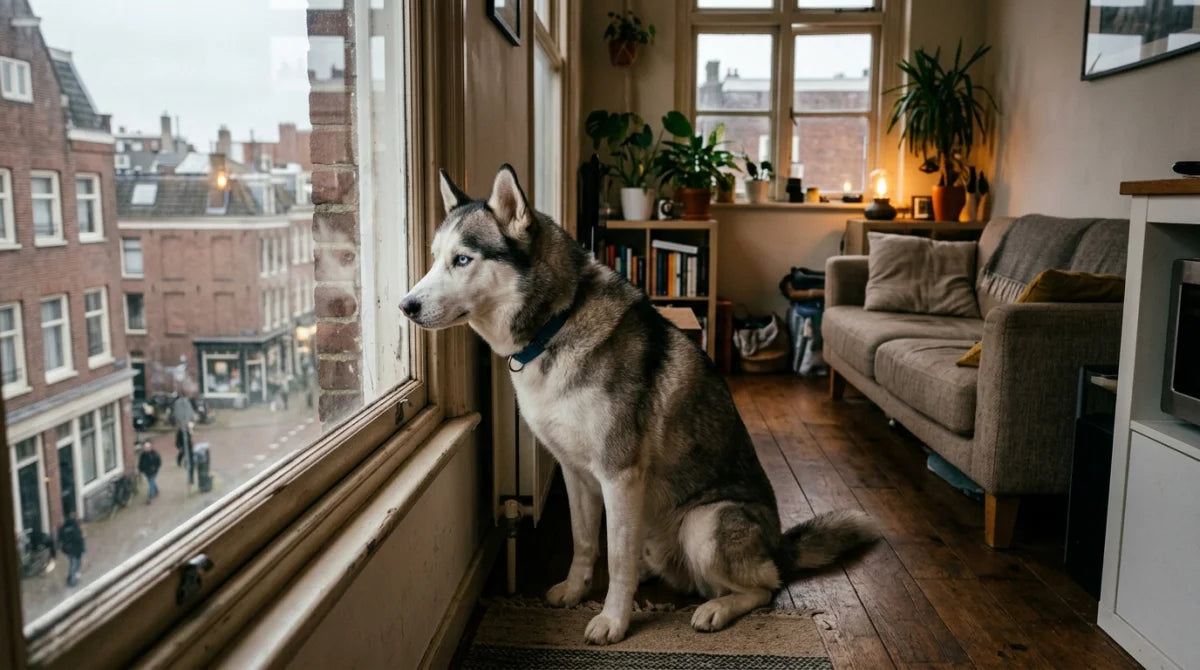
Every year, thousands of dogs end up in shelters because someone watched a TikTok, fell in love with a pretty face, and discovered six months later that their studio apartment was not, in fact, big enough for a dog bred to run 30 miles a day.
This list isn't about size. Plenty of big dogs do great in apartments (Greyhounds are the most famous example — 70-pound couch potatoes). It's about energy, noise, and drive — the things that make a dog miserable in a small space, and your neighbors miserable in theirs.
If you live in an apartment and own one of these breeds, I'm not judging you. I'm saying you're probably exhausted.
1. Siberian Husky — The Escape Artist
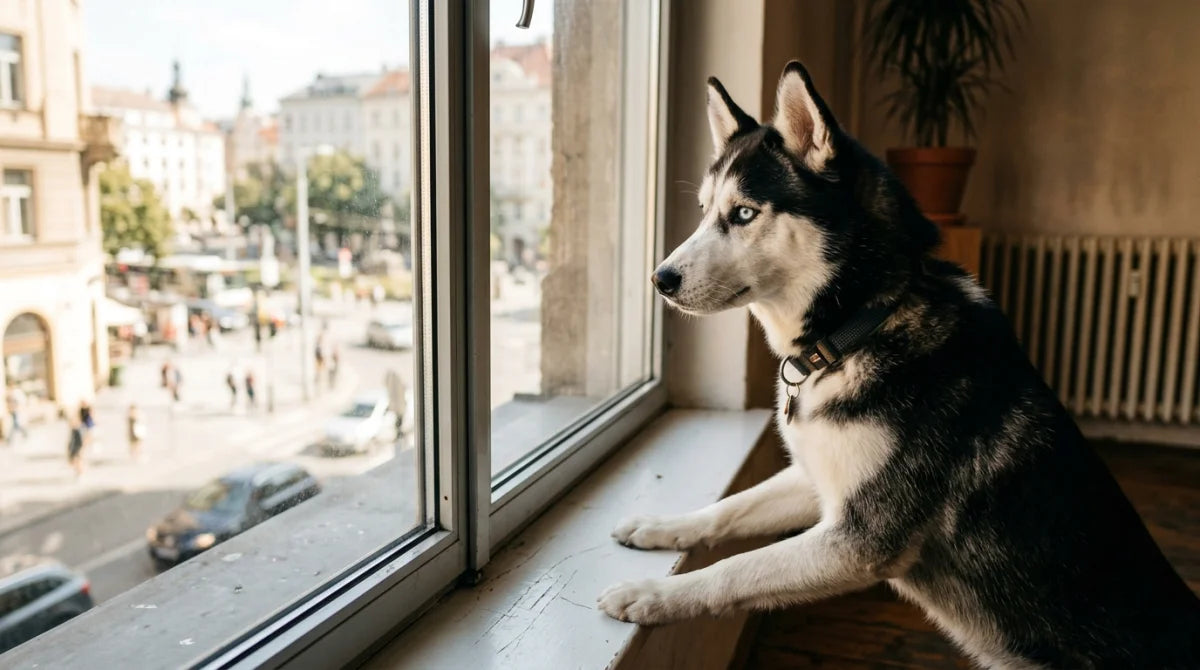
The Siberian Husky is one of the most stunning dogs on the planet. Those ice-blue eyes. That wolf-like face. The dramatic coat. They look like they were designed to sell Instagram followers.
They were also designed to run 100+ miles a day pulling a sled through the Arctic.
In an apartment: A bored Husky will howl (not bark — howl, at a volume that travels through walls, floors, and your landlord's patience). It will destroy furniture, dig through carpet, and find escape routes you didn't know existed. Huskies can jump 6-foot fences, open doors, and squeeze through gaps that seem physically impossible. They also blow their undercoat twice a year in a fur explosion that will make your apartment look like it snowed indoors.
What they actually need: A minimum of 2 hours of vigorous exercise daily. A securely fenced yard. A human who runs, bikes, or does dog sports. Ideally, another Husky to play with, because a solo Husky is a lonely Husky, and a lonely Husky is a destructive Husky.
2. Border Collie — The Workaholic
The Border Collie is the smartest dog breed in the world. That's not an opinion — virtually every canine intelligence study puts them at or near the top. They can learn hundreds of commands. They can solve problems that confuse other breeds entirely.
This is a nightmare in an apartment.
In an apartment: A Border Collie without a job is a Border Collie that will invent a job. Usually that job involves herding your cat, obsessively chasing light reflections, reorganizing your shoes, or developing neurotic compulsive behaviors. They don't get "bored" the way other dogs do — they get mentally ill. Understimulated Border Collies develop anxiety, OCD-like behaviors, and destructive tendencies that no amount of walks can fix.
What they actually need: Herding work, competitive agility, advanced obedience, or some other form of intensive mental + physical challenge. Daily. Forever.
3. Australian Shepherd — The Border Collie's Slightly More Social Cousin
Everything said about Border Collies applies to Australian Shepherds, with one addition: Aussies are more socially needy. They don't just need exercise and mental stimulation — they need to be with you while getting it. An Aussie left alone in an apartment all day while you're at work is a recipe for separation anxiety, destructive behavior, and noise complaints.
The Miniature Australian Shepherd scam: "But I got a Mini Aussie — they're apartment-sized!" Same brain, same drive, same herding instinct, smaller body. You just made the problem more portable.
4. Dalmatian — The High-Octane Disaster
Blame 101 Dalmatians. Every few years, the movie resurfaces, a new generation falls in love with those spots, and shelters brace for the wave of surrendered Dalmatians that follows about 12 months later.
In an apartment: Dalmatians were bred to run alongside horse-drawn carriages for miles. They're large (45-70 pounds), extremely energetic, and can be high-strung and reactive in confined spaces. They're also prone to deafness (about 30% are born deaf in one or both ears), which compounds behavioral challenges in a noisy urban environment. Many are also not great with strangers — not aggressive, but aloof and anxious in a way that makes elevator encounters tense.
What they actually need: Serious daily exercise (running, not walking), a patient owner who understands their quirks, and enough space to decompress.
5. Jack Russell Terrier — The Tiny Terrorist
The Jack Russell Terrier proves that apartment suitability has nothing to do with size. At 13-17 pounds, they should be perfect for small spaces. They are not.
In an apartment: Jack Russells operate at approximately 110% intensity at all times. They bark at everything. They jump to heights that seem to violate physics. They dig through cushions, carpets, and occasionally walls. They have a prey drive so intense they'll stalk a housefly with the focus of a lion on a gazelle. And they don't tire out — a JRT that's had an hour-long walk will come home, vibrate for 30 seconds, and then ask what's next.
What they actually need: A house with a yard, ideally with something to hunt (or at least chase). Barn hunt, terrier trials, or a very active owner who genuinely enjoys being tired.
6. Weimaraner — The Gray Ghost of Anxiety
The Weimaraner is gorgeous — that silvery coat, those amber eyes, that lean athletic build. They're also one of the most separation-anxiety-prone breeds in existence.
In an apartment: A Weimaraner left alone will pace, whine, bark, and systematically destroy whatever it can reach. They've been known to chew through drywall. They require both intense physical exercise AND constant human companionship — a combination that's essentially impossible if you have a 9-to-5 job and a 700-square-foot apartment.
7. Belgian Malinois — The Military Dog in Your Living Room
The Belgian Malinois has become wildly popular thanks to military and police dog documentaries. It is, pound for pound, probably the most driven, intense, capable working dog alive.
In an apartment: You have made a terrible mistake. A Mal without a job is a 60-pound bundle of nuclear energy with a bite force of 195 PSI. This is a dog that needs hours of work daily — not walks, work. Protection training, scent detection, competitive obedience, agility. Anything less and you'll come home to discover your Malinois has disassembled your furniture and is waiting on the roof.
This dog is on this list not because it's bad — it's extraordinary. But it is spectacularly wrong for apartment life, and the surge of impulse purchases based on "cool military dog" TikToks is filling shelters with young Mals that nobody is equipped to handle.
8. German Shorthaired Pointer — The Athlete Who Never Stops
The German Shorthaired Pointer is currently the 9th most popular breed in America, and a frightening number of them live in apartments. GSPs were bred to hunt all day — pointing, retrieving, swimming, running — in an era when "all day" meant sunrise to sunset.
In an apartment: Restless, destructive, vocal, and physically incapable of relaxing. A GSP will pace your apartment like a caged tiger, knock over everything with its tail (constantly wagging at devastating speed), and develop anxious habits that make you both miserable.
9. Akita — The Silent Guardian Who Hates Your Neighbors
The Akita is quiet, clean, and relatively calm indoors. So why is it on this list?
In an apartment: The problem isn't energy — it's temperament. Akitas are protective, often dog-aggressive, and territorial in a way that makes shared hallways, elevators, and dog parks into potential conflict zones. A 100-pound Akita that decides it doesn't like the Labrador in the elevator is a crisis, not an inconvenience. They also require experienced handling and extensive socialization that's much harder to provide in a dense urban environment.
10. Vizsla — The Velcro Dog With a Sprint Habit
The Vizsla is what happens when you combine a marathon runner's energy with a toddler's need for constant attention. They're affectionate, athletic, and relentlessly attached to their humans.
In an apartment: A Vizsla that doesn't get 1-2 hours of hard running daily will redirect that energy into anxiety, whining, and destructive behavior. They also develop severe separation anxiety — a Vizsla alone in an apartment is a Vizsla that's howling, pacing, and wondering why you abandoned it (even if you just went to the grocery store).
So What CAN Live in an Apartment?
Good apartment dogs aren't defined by size — they're defined by energy level, noise level, and ability to self-soothe. Some genuinely great apartment breeds:
Actually Good Apartment Dogs
Cavalier King Charles Spaniel — the gold standard for apartment life
French Bulldog — built for it (health concerns aside)
Greyhound — the 70-pound couch potato surprise
Shih Tzu — literally bred for palace life
Havanese — adaptable, quiet, happy anywhere
Chihuahua — small and surprisingly low-energy (barking aside)
Basset Hound — too lazy to care about square footage
Maltese — tiny, calm, genuinely apartment-shaped
The Bottom Line
Every dog on this list is a magnificent breed. Not one of them is "bad." They're just bad for apartments — and pretending otherwise does a disservice to both the dog and the owner.
If you live in a small space and want a dog, choose one whose needs match your reality, not your aesthetic preferences. The prettiest dog in the world is the one that's actually happy in your home.