 Wender Pets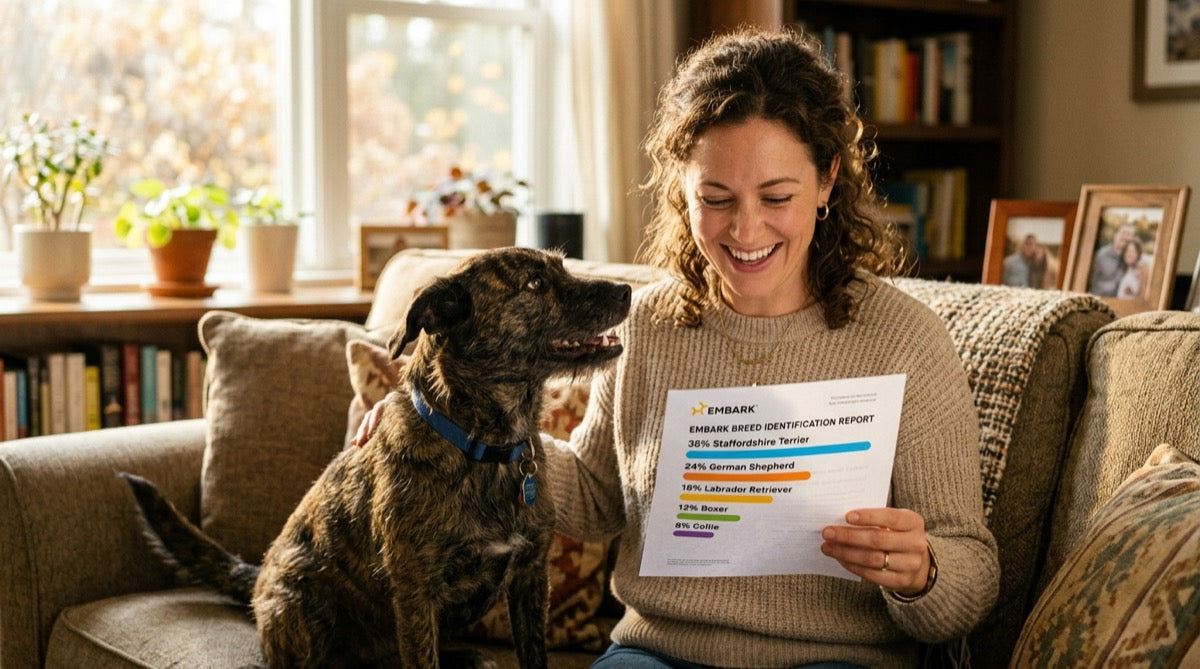
The Moment the Results Land
The moment the Embark or Wisdom Panel results arrive is a specific kind of excitement. You have been saying "I think she is part Lab?" for two years. You have squinted at her ears and Googled "dogs with brindle patches" at 11 p.m. more times than you would admit. Now you have a pie chart. And it is — well — more complicated than expected.
34% Labrador Retriever. 22% Boxer. 18% American Bulldog. 12% Australian Shepherd. 14% "Supermutt." You stare at it. Your dog stares at you. Neither of you is entirely sure what to do next.
Here is the thing most people miss: those percentages are not just cocktail-party trivia. They are a behavioral blueprint. They explain why your dog does the things she does — why she retrieves every sock in the house, why she greets strangers by launching her entire body at their chest, why she fixates on the cat with an intensity that borders on professional. They tell you what she needs from you and, honestly, why you fell for her in the first place.
This guide walks you through how to actually read your results, what each percentage tier means in practice, and what to do with the information once you have it. Because knowing your dog is 34% Lab is interesting. Understanding what that means for her daily life is useful.
The Dominant Breed Is the One That Matters Most
The first breed on your results list — the one with the highest percentage — drives roughly 40 to 60 percent of your dog's behavior, instincts, energy level, and even health risks. Even if your dog is technically a "mix of five things," she thinks like her dominant breed most of the time. That breed shaped her wiring. Everything else is seasoning.
This is why two "mixed breeds" from the same shelter can behave like entirely different species. A dog that is 38% Border Collie will herd, fixate, make intense eye contact, and need a job — even if the rest of her DNA is Chow Chow and Beagle. That Border Collie programming runs deep. It is the operating system. The Chow and Beagle are apps running on top of it.
A dog whose top breed is 45% German Shepherd will be loyal, alert, a little suspicious of strangers, and attached to you with a devotion that borders on surveillance. It does not matter if the other 55% is a grab bag of hound and terrier. The Shepherd is in the driver's seat.
So when you open your results, start there. Research that dominant breed — not casually, but seriously. Learn what it was originally bred to do, because that instinct has not disappeared just because your dog sleeps on your couch. It is the key to understanding everything about her.
Reading Each Breed in the Mix
Not all percentages are created equal. Here is how to interpret each tier of your results, from the breed that is running the show to the ones that are barely whispering in the background.
Breed Percentage Decoder
40%+ — This is your dog.
This breed drives her core personality, energy level, and instincts. When you describe your dog to someone, you are describing this breed's traits. Her exercise needs, her social style, her trainability — all primarily determined here.
20–39% — Strong secondary influence.
This is the "quirk" breed. It explains the habits that do not quite fit the dominant breed — the unexpected stubbornness in an otherwise eager-to-please dog, the random howling from a dog that is mostly retriever, the bursts of speed from a dog whose top breed is a couch potato. This tier matters more than most people think.
10–19% — Flavor notes.
At this level, you are more likely to see physical traits than behavioral ones. Ear shape, coat texture, body proportions, size — these are the telltale signs. A 15% Dachshund influence might explain why your medium-sized dog has suspiciously short legs and a surprisingly long body.
Under 10% — Background noise.
Interesting trivia for your next dinner party, but not a behavioral driver. At this level the DNA is so diluted that it rarely manifests in any observable way. File it under "fun fact" and move on.
Let's walk through a real-world example. Say your rescue dog's results come back as: 42% Labrador Retriever, 24% Boxer, 19% Australian Cattle Dog, 15% Basenji.
Your dog's core personality is Labrador — food-motivated, eager to please, soft-mouthed, socially confident, and driven to retrieve anything that is not nailed down. She probably loves water, inhales meals, and melts into whoever is petting her. That is the Lab at 42%. It is the operating system.
The 24% Boxer explains the clownishness. Your dog does not just greet people — she launches at them, full body, face first, with a wiggling intensity that looks like she might explode. She plays hard, has sudden bursts of unhinged energy (the classic Boxer "zoomies"), and may use her paws more like hands than most dogs do. That is the Boxer influence — physical comedy in canine form.
The 19% Australian Cattle Dog is a flavor note, but a potent one. It might explain why your otherwise friendly dog occasionally nips at heels — that is the cattle dog herding instinct surfacing. It could also explain a stubborn streak that seems out of character for a Lab-dominant dog, or an unusual level of alertness and suspicion toward strangers.
The 15% Basenji is the wildcard. Basenjis are ancient, independent, and famously difficult to train — not because they are unintelligent but because they do not particularly care what you want. If your dog occasionally ignores a command she clearly knows, stares at you with an expression that says "I heard you, I just disagree," and has an oddly cat-like grooming habit, that is the Basenji whispering.
What Each Common Rescue Breed Brings to the Mix
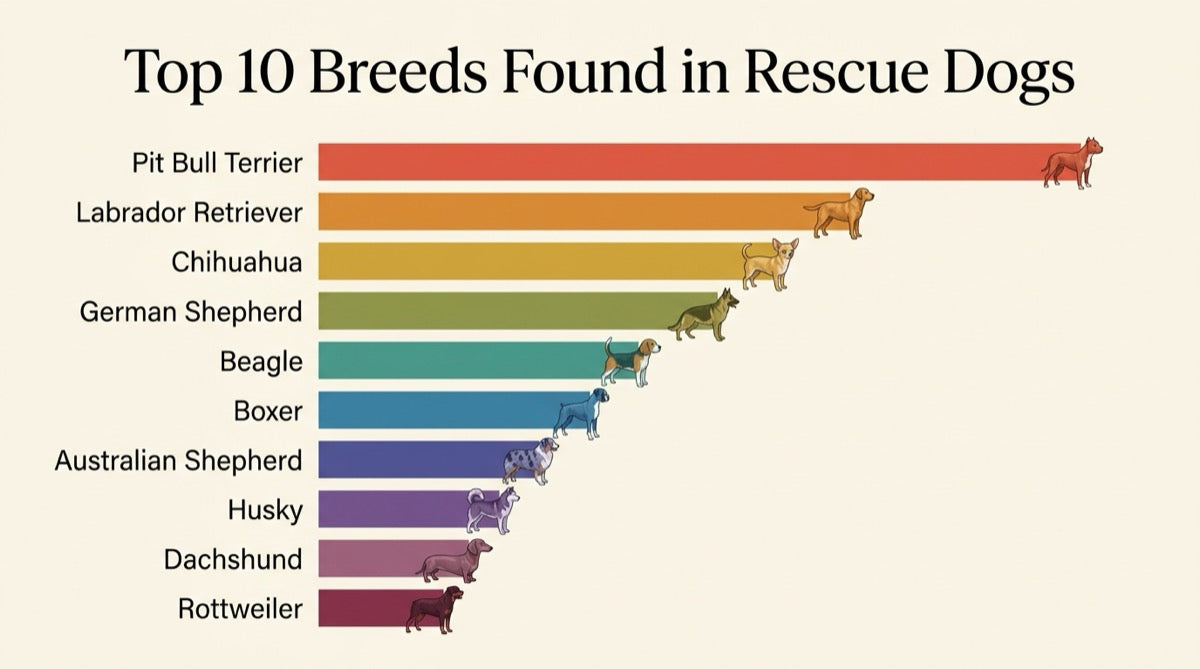
Certain breeds show up in rescue dog DNA results over and over. This is not a coincidence — these are the breeds that are most commonly bred, most commonly surrendered, and most commonly part of unplanned litters. Here is what each one contributes when it appears in a mix.
Labrador Retriever — The universal donor of the dog world. Labs bring eagerness to please, food motivation that borders on obsession, a soft mouth, and a deep, uncomplicated love of people. In a mix, Lab DNA usually makes a dog more trainable, more social, and significantly more interested in whatever you are eating. Labs are the reason your rescue brings you things — shoes, toys, the occasional dead bird — and looks at you like it is the greatest gift anyone has ever given.
German Shepherd — Loyalty turned up to eleven. German Shepherd DNA brings protectiveness, velcro-dog attachment to one person, intelligence that requires stimulation, and a natural suspicion of anything unfamiliar. In a mix, expect a dog that follows you from room to room, positions itself between you and strangers, and learns commands with almost unsettling speed. Also expect shedding. Truly legendary amounts of shedding.
Boxer — Pure, unfiltered clownishness wrapped in muscle. Boxers bring energy bursts, face-first affection, and a physical style of play that involves full-body contact. In a mix, Boxer DNA produces a dog that makes everyone laugh, has no concept of personal space, and expresses joy with its entire body. They also bring a stubborn streak that is charming until you need them to do something they do not want to do.
Beagle — A nose with a dog attached. Beagle DNA brings scent-driven behavior that overrides almost everything else, a howl that can be heard three blocks away, and a stubbornness that is really just single-minded focus on whatever the nose has found. In a mix, expect a dog that disappears into bushes mid-walk, bays at squirrels with operatic intensity, and cannot be recalled once a scent trail has been acquired. Lovable. Infuriating. Often simultaneously.
Australian Shepherd — The overachiever. Aussie DNA brings herding instinct, intense eye contact that can feel like being read, and an absolute need for a job. In a mix, Australian Shepherd influence produces a dog that stares at you during conversations (it is watching your mouth), tries to organize groups of children or other dogs by circling them, and becomes genuinely anxious without enough mental stimulation. Brilliant, devoted, and slightly intense.
Chihuahua — Do not let the size fool you. Chihuahua DNA brings alertness that borders on hypervigilance, a big-dog attitude in a tiny package, and fierce loyalty to one person above all others. In a mix, Chihuahua influence often manifests as a dog that barks at everything, bonds with surgical precision to one human, and carries itself with a confidence that has absolutely no relationship to its physical dimensions.
Siberian Husky — Independence and drama in equal measure. Husky DNA brings escape artistry, dramatic vocalizing (not barking — actual talking), and a stubborn independence that makes training feel like a negotiation between equals. In a mix, expect a dog that tests fences, howls when it disagrees with you, and has a running endurance that will outlast any owner who is not actively training for an ultramarathon.
Rottweiler — Quiet confidence and calm power. Rottweiler DNA brings a protective instinct that is less about aggression and more about positioning — a Rottweiler mix will place itself between you and a perceived threat with a stillness that is more intimidating than any bark. In a mix, expect a dog that is gentle with family, wary with strangers, and has a gravity to its presence that makes it clear nobody is getting past without permission.
Dachshund — A stubborn streak forged in badger dens. Dachshund DNA brings burrowing behavior (your dog will tunnel under blankets like it is digging to China), bold confidence that ignores body size, and a bark that is five times louder than physics should allow. In a mix, Dachshund influence often produces a dog that refuses to walk in rain, loves being under covers, and picks fights with dogs three times its size without a flicker of doubt.
Chow Chow — The introvert's dog. Chow DNA brings aloof independence, one-family loyalty, and a cat-like detachment from the approval of strangers. In a mix, expect a dog that is deeply bonded to its household but could not care less about impressing the neighbor. Chow mixes are often described as "not really a dog person's dog" — which is exactly why certain owners love them.
Australian Cattle Dog — Relentless energy wrapped in paradox. Cattle Dog DNA brings a nipping instinct from centuries of heel-biting cattle work, stamina that outlasts most owners by hours, and a personality that is simultaneously velcro-attached and fiercely independent. In a mix, expect a dog that follows you everywhere, nips at ankles when excited, and has an intensity in its eyes that makes you feel like you are its entire project.
Border Collie — The fixator. Border Collie DNA brings laser focus, an intense stare that can move livestock (and guilt-trip owners), and a work ethic that does not have an off switch. In a mix, Border Collie influence produces a dog that herds everything — children, cats, roommates, your feelings. It watches, it waits, it calculates. A Border Collie mix without a job is not lazy. It is plotting.
The "Supermutt" Percentage — What It Actually Means
Many DNA results include a percentage labeled "Supermutt," "breed groups," or sometimes "village dog." First-time DNA testers often interpret this as a failure — like the test just gave up and shrugged. It is not.
What "Supermutt" actually means is that your dog carries ancient dog genetics that predate modern breed development. Modern dog breeds are a relatively recent invention — most were standardized in the last 150 to 200 years. Before that, dogs bred based on geography, climate, and function, not kennel club standards. Those ancient lineages still exist in the gene pool, and when they show up in your dog's DNA, the test cannot assign them to any single recognized breed because they come from before breeds existed.
Village dogs — the free-roaming, self-selecting dogs that still exist in many parts of the world — carry this kind of genetic diversity. And here is the part that should make you feel good: these genetics are often associated with hybrid vigor. Dogs with more genetic diversity tend to have fewer breed-specific health problems, stronger immune systems, and longer lifespans than their purebred counterparts. Your dog's Supermutt percentage is not a blank space in its identity. It is the oldest, most resilient dog DNA on the planet. It is a feature, not a bug.
What to Do With the Results
So you have your breakdown. You know what is in the mix. Now what? Here is how to actually use this information to make your dog's life better.
1. Research your dominant breed — seriously. Not a five-minute skim of a breed overview. Go deep. Learn what that breed was originally created to do, because that instinct has not disappeared. A dog that is 40% Labrador Retriever was built to retrieve waterfowl in freezing water for hours. That drive is still in there. It explains the fetching, the water obsession, the soft mouth, the endless willingness to do the same task over and over. Understanding the job helps you give the dog an outlet that satisfies the same instinct — even if the job is now "bring back the tennis ball" instead of "retrieve a duck from a frozen lake."
2. Adjust your exercise plan. This is where the results pay for themselves. High-energy mixes — especially combinations like Siberian Husky plus Australian Shepherd — need two or more hours of real, vigorous activity daily. Not a leisurely walk. Running, hiking, agility, or sustained fetch sessions. Lower-energy mixes — combinations like Basset Hound plus Chow Chow — need enrichment more than endurance. Puzzle toys, scent games, short but interesting walks with lots of sniffing. Match the exercise to the DNA, not to what you assume a "medium-sized dog" needs.
3. Talk to your vet — with specifics. Certain breeds carry genetic predispositions to specific health conditions. A dog with significant German Shepherd DNA should be monitored for hip dysplasia. A dog with Boxer in the mix has elevated cancer risk. A dog with Dachshund heritage needs spinal health monitoring. Bring your DNA results to your next vet appointment and ask which breed-specific screenings are worth doing. This is not paranoia — it is preventive care informed by actual data.
4. Celebrate your dog specifically — not generically. She is not just "a rescue." She is not just "a mutt." She is a Labrador Retriever-dominant, Boxer-quirked, Basenji-independent individual with a name and a personality you have earned the right to understand. The DNA test does not change who your dog is. It gives you the vocabulary to describe what you have been observing all along — and the knowledge to give her exactly what she needs.
Your dog has been telling you who she is since the day you brought her home. Now you have the translation guide.